Summary
In the Mind in Movement Lab, we use tools and concepts from cognitive psychology, motor control, and biomechanics to inform 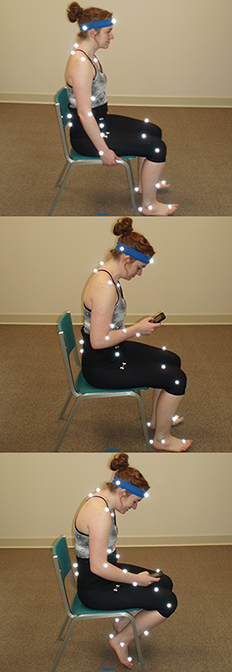 questions about posture and voluntary movement in healthy young adults and in the context of aging, Parkinson's disease, fall risk, and musculoskeletal pain. We are investigating the idea that cognitive factors such as inhibitory control and body awareness influence postural alignment and muscle tone, which in turn affect balance, mobility, fall risk, and musculoskeletal pain – and that these influences flow in other directions, too.
Inspiration
Many of our questions were inspired by somatic practices. Also known as mindful movement, these are activities that build proprioceptive awareness through particular ways of attending to the self and the world during movement. Often explored for the sense of joyful embodiment they can promote, evidence suggests that somatic practices also bring a unique set of tools to interrupt patterns of psychological stress and musculoskeletal pain. Many of the practices, such as Aikido, Tai Chi, and Ballroom dancing, are focused on specific movement sequences. Others, like Contact Improvisation and Alexander technique, are not. Either way, the deepest benefits seem to accrue when learners attend carefully to the mind-movement junction: choosing not to react automatically, observing precisely, and proceeding with clear intention. We are pursuing 5 overlapping lines of work.
Current Lines of Work
1. Developing Theoretical Frameworks for Somatic Practices
We are exploring the roles of postural muscle tone, attention, and mindfulness in understanding how somatic practices work and why they are effective.
View Publications
Cacciatore, Johnson, & Cohen (2020) — Potential mechanisms of the Alexander Technique: Toward a comprehensive neurophysiological model. Kinesiology Review.
Cacciatore, Anderson, & Cohen (2024) — Central mechanisms of muscle tone regulation: Implications for pain and performance. Frontiers in Neuroscience.
Hodges, Cohen, & Cacciatore (2024) — Modern pain science and Alexander Technique: How might Alexander Technique reduce pain? Kinesiology Review.
Johnson, Brandes, Door, & Cohen (2025) — Pause, observe, intend: A qualitative study exploring expert practitioners' perceptions of how mindfulness and Alexander Technique work synergistically. European Journal of Integrative Medicine.
2. Alexander Technique
We conduct experimental studies that test the effectiveness of this somatic practice and also try to elucidate its mechanisms. Much of this work has been done in collaboration with the Poise Project, whose mission is to bring a scientifically-validated embodied empowerment approach to broad populations, starting with care partners and people with Parkinson's disease.
View Publications
Becker et al. (2018) — Alexander Technique group classes for neck pain. Complementary Therapies in Medicine.
Becker, McIsaac, Copeland, & Cohen (2021) — Alexander Technique vs. targeted exercise for neck pain: A preliminary comparison. Applied Sciences.
Johnson & Cohen (2023) — Altered coordination strategies during upright stance and gait in teachers of the Alexander Technique. Frontiers in Aging.
Gross et al. (2022) — Poised for Parkinson's: Adapting an in-person cognitive embodiment course to online delivery for people living with Parkinson's disease and their care partners. International Congress of Parkinson's Disease and Movement Disorders.
Gross et al. (2022) — 'Partnering with Poise': Alexander technique online group classes are a promising intervention to decrease loss-of-self and increase agency for care partners of people living with dementia. Alzheimer's Association International Conference.
3. Postural Intention
We study the effects of different kinds of postural instruction on activities from balance to partner dancing, across healthy subjects and those with Parkinson's disease. We have found that a light upward intention – with an emphasis on preventing any impulse to shorten and compress the spine – improves balance, makes tone more adaptable, and makes movements smoother, in contrast to effortful "pull yourself up tall" instructions.
View Publications
Cohen et al. (2015) — Lighten Up! Specific postural instructions affect axial rigidity and step initiation in Parkinson's disease. Neurorehabilitation and Neural Repair.
Cohen, Baer, Ravichandra, et al. (2020) — Lighten Up! Postural instructions affect static and dynamic balance in healthy older adults. Innovation in Aging.
Cohen & Hocketstaller (2023) — Postural instructions affect postural sway in young adults. Gait & Posture.
Hillend & Cohen (2025) — Lighten Up: Postural frame instructions affect connection, confidence, and enjoyment in partner dancing. Rocky Mountain Psychological Association.
4. Cognitive Causes and Consequences of Forward Head Posture
Our bridge to human factors and ergonomics. Forward head posture may contribute to neck pain, the 4th leading cause of disability in the US. We hypothesize that upright posture is facilitated by inhibitory control – the ability to prevent oneself from pulling the head forward in response to compelling stimuli – and that forward head posture in turn places cognitive burdens on the individual.
View Publications
Baer, Vasavada, & Cohen (2019) — Neck posture is influenced by anticipation of stepping. Human Movement Science.
Baer, Vasavada, & Cohen (2022) — Posture biofeedback increases cognitive load. Psychological Research.
Baer & Cohen (2023) — Does neck flexion improve performance? Effects on reaction time depend on whether responses are expected.
Cohen, Baer, et al. (2026) — Forward head posture: Cognitive causes and cognitive consequences. Rocky Mountain Psychological Association.
5. Proprioception and Postural Tone
Our newest line of work. To assess axial muscle tone during standing, we use Twister [link to JoVE article — URL needed], our unique custom device. We are exploring the relations among tone, proprioception, and body awareness, and have recently begun using EEG to investigate these questions (in progress).
View Publications
RMPA 2026 — Postural tone, awareness, and proprioception.
RMPA 2026 — EEG in Twister.
Science Outreach
Dr. Cohen has teamed up with several other scholars to develop a website devoted to exploring the scientific foundations of Alexander Technique.
Dr. Cohen has been interviewed by Alexander Studies Online about the "Lighten Up" series of studies.
Dr. Cohen participated in an AT research panel in 2021.
The theoretical paper by Drs. Cacciatore, Johnson, and Cohen was used as part of a video about the Alexander Technique.
Dr. Cohen and several other scholars are developing a website devoted to exploring the scientific foundations of postural tone.
Links to Previous Research
PubMed Research PublicationsGoogle Scholar